

Qiongzhou Strait Cross-Sea Bridge
2015-12-28
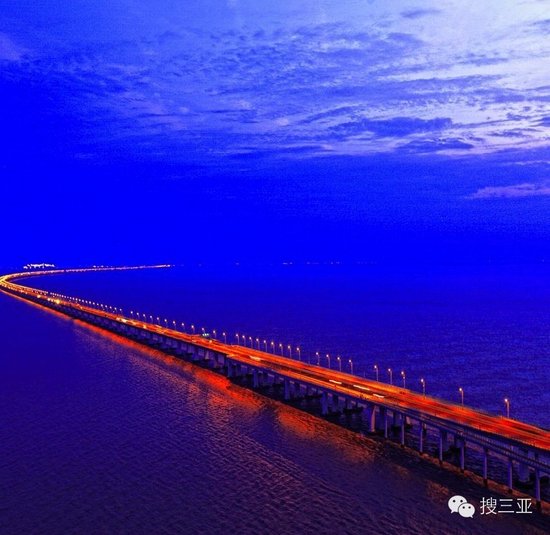
The "Qiongzhou Strait Cross-Sea Engineering Planning Study Report," jointly prepared by the Ministry of Transport, the Ministry of Railways, and the provinces of Guangdong and Hainan, has now been completed. The report identifies the construction of a combined road and rail bridge connecting Denglujiao in Xuwens County, Guangdong Province, to Daolunjiao in Chengmai County, Hainan Province, as the preferred solution for the Qiongzhou Strait cross-sea project. The bridge’s offshore section will span 26.3 kilometers—making it the second-longest bridge in the world, behind only the newly completed Hangzhou Bay Bridge.
The "Qiongzhou Strait Cross-Sea Engineering Planning Study Report," jointly prepared by the Ministry of Transport, the Ministry of Railways, and the provinces of Guangdong and Hainan, has now been completed. The report identifies the construction of a combined road and rail bridge connecting Denglujiao in Xuwens County, Guangdong Province, to Daolunjiao in Chengmai County, Hainan Province, as the preferred solution for the Qiongzhou Strait cross-sea project. The bridge’s offshore section will span 26.3 kilometers—making it the second-longest bridge in the world, behind only the newly completed Hangzhou Bay Bridge.
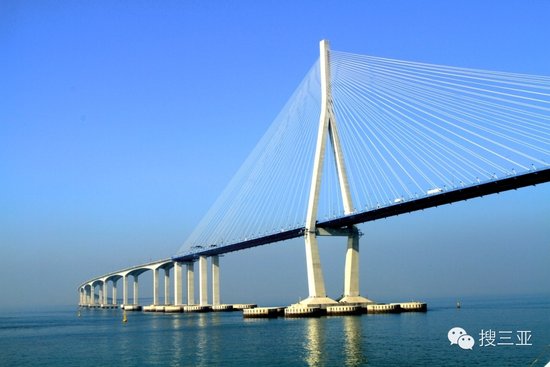
According to the design outlined in the "Qiongzhou Strait Cross-Sea Engineering Planning Study Report," the proposed Qiongzhou Strait Bridge will feature two separate levels: an upper level for road traffic and a lower level dedicated to railways. The railway bridge is designed for a maximum speed of 160 kilometers per hour, while the highway bridge will accommodate vehicles traveling at up to 100 km/h. Once completed, driving across the Qiongzhou Strait via the bridge will take just 20 minutes—significantly faster than the current ferry-based journey, which typically requires about 5 hours, including waiting time and the actual boat ride.
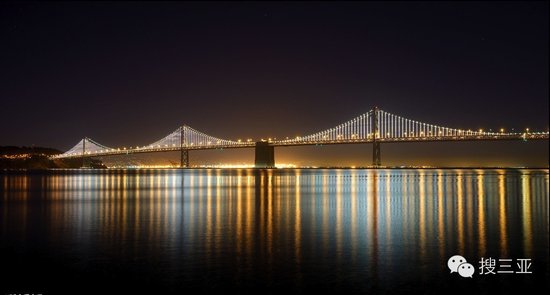
On the 8th in Beijing, the Ministry of Transport, the Ministry of Railways, and the provinces of Guangdong and Hainan signed an agreement. The four parties will jointly submit a proposal for the Qiongzhou Strait Cross-Sea Passage project to the National Development and Reform Commission next year. The goal is to begin construction of the Qiongzhou Strait Bridge in 2017 and complete and open it to traffic by 2025. The project’s estimated static investment is approximately 20 billion RMB, which will be jointly funded by the Ministry of Transport, the Ministry of Railways, and the two provinces of Guangdong and Hainan.
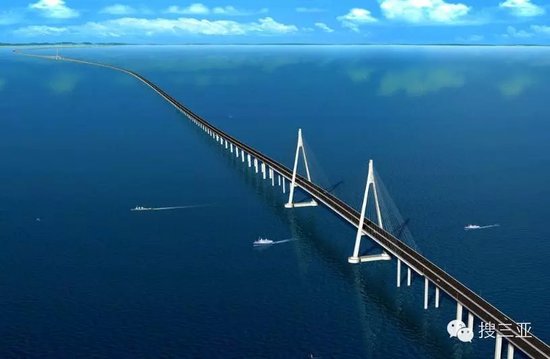
Once the Qiongzhou Strait Cross-Sea Bridge is completed, Hainan Province's capital, Haikou, will see its 6-hour economic circle expand to include Guangzhou, Guilin, and Nanning, while the 12-hour economic zone could reach as far as Wuhan and Shanghai—resulting in a significant improvement in transportation efficiency. This project will not only play a crucial role in boosting the economic and social development of Hainan and western Guangdong but also hold immense significance for developing南海 resources, advancing the nation’s energy strategy, strengthening regional cooperation across the Pan-Pearl River Delta area, fostering growth in the Beibu Gulf region, and accelerating the establishment of the China-ASEAN Free Trade Area.
The construction of the Qiongzhou Strait Cross-Sea Passage has received high attention from every Chinese leader over the years. As early as 1974, Premier Zhou Enlai issued instructions calling for the organization of studies on building a cross-sea passage across the Qiongzhou Strait.
Currently, under the guidance of the National Development and Reform Commission, the Ministry of Transport, the Ministry of Railways, and the provinces of Guangdong and Hainan have established a Leading Group for Preliminary Work on the Qiongzhou Strait Cross-Sea Project, along with a Technical Advisory Group and a Research Task Force, working together to advance the project's preparatory stages.
The Qiongzhou Strait is one of China's three major straits, with an average channel width of 29.5 kilometers and water depths ranging from 40 to 160 meters. According to forecasts from Hainan Province's Department of Transportation, by 2020, the province's total demand for cross-sea transportation is expected to reach 56 million passenger trips, while cargo volume will surge to 93.7 million tons.
On the 9th, relevant officials from Guangdong's Zhanjiang transportation department announced plans to build a cross-sea bridge across the Qiongzhou Strait, with its northern terminus located in Xuwen County, Zhanjiang. The bridge will feature two separate levels: an upper railway level designed for four-track operations, accommodating passenger trains traveling at up to 160 km/h and freight trains at 120 km/h, and a lower road level optimized for vehicles moving at speeds of up to 100 km/h. The total estimated investment for the project exceeds 140 billion RMB.
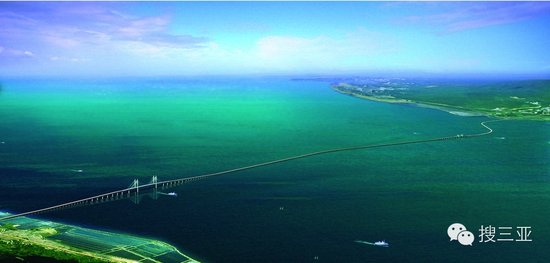
The Qiongzhou Strait, hailed as the "Golden Waterway," is one of China’s three major straits. Stretching approximately 80 kilometers from east to west and averaging nearly 30 kilometers in width from north to south, it serves not only as a vital maritime corridor connecting the Beibu Gulf with the central and eastern parts of the South China Sea but also as a shortcut for sea routes between Guangdong province, Hainan Island, and destinations like Vietnam. As early as more than 800 years ago, Li Guang, a demoted official during the Song Dynasty, conceived the idea of linking the two sides of the strait. Later, during the late Qing era, Zhang Zhidong, a prominent statesman known for his advocacy of Western-style modernization, proposed the ambitious plan to build a railway across the strait, extending deep into Hainan’s interior. Moreover, in the 1970s, Premier Zhou Enlai instructed Wan Li, who at the time served as Vice Premier of the State Council, to lead a team in studying the feasibility of constructing a passage spanning the Qiongzhou Strait.
The natural barrier of the Qiongzhou Strait has long served as an impassable chasm, severing communication between the two sides. From ancient times—when people fashioned hollowed-out tree trunks into dugout canoes and bamboo rafts—to the days of manually rowed wooden boats ferrying passengers across, and later to sailboats, motor-sailers, and even electrically powered car ferries—and now, state-of-the-art train ferries—throughout millennia, generations have dreamed of conquering this formidable stretch of water.
According to elderly residents of Shiwai Village in Nanshan Town, Xuwu County—villagers who have lived for generations along the shores of the Qiongzhou Strait—archaeological experts unearthed 16 dugout canoes in 1976 at an ancient Yue settlement on the Leizhou Peninsula. This discovery led researchers to conclude that during prehistoric times, the Yue people from the mainland relied heavily on dugout canoes as their primary means of transportation, using the strait as a vital route to connect with Hainan Island. During the Tang and Song dynasties, wooden boats propelled by human-powered oars became a crucial method for crossing the Qionghai Strait. Later, as wind-powered sailing technology advanced, wooden sailboats gradually replaced the oar-driven craft, taking over the role of ferrying passengers and goods across the waterway. According to historical records, the main cargo carried by these large wooden sailboats in the Qiongzhou Strait included sugarcane, rattan (both red and white), traditional Southern medicines, cotton, and textiles—goods that played a pivotal role in supporting both the region’s agricultural production and the daily lives of local communities on both sides of the strait.

The construction of the Qiongzhou Strait Cross-Sea Passage is a major initiative to enhance the nation's transportation network within the broader context of China's development strategy. It not only exemplifies the country's growing strength but also fulfills humanity's age-old dream of overcoming the formidable natural barrier posed by the strait.
On the 9th, officials from Zhanjiang's transportation department stated that Guangdong Province has been conducting a series of specialized studies on building a cross-sea passage since 1994. Last March, China’s Ministry of Transport, Ministry of Railways, along with Guangdong and Hainan provinces, held their first joint meeting, officially designating the Qiongzhou Strait Bridge as a dual-use structure capable of accommodating both highway and railway traffic. Once completed, driving across the Qiongzhou Strait will take just 20 minutes, while train travel will be reduced to under 10 minutes. Currently, the project’s planning and research phase has been fully finalized and approved by experts. Specialists are now comparing and evaluating two proposed bridge site options, aiming to kick off construction in 2018 and complete the project by 2025, ready for full operation.
When will the majestic and spectacular Qiongzhou Strait Cross-Sea Bridge finally be completed, connecting China’s mainland with the Pearl of the South Sea—Taiwan Island—and ensuring that even the farthest corners of the country are no longer separated by the vast waters to the south?
We’ve heard that the preliminary work for the Qiongzhou Strait Cross-Sea Project has been included in national planning. The project’s approval process involves four key areas—passenger and cargo transportation, structural design, marine environment surveys and engineering geological exploration, as well as critical equipment and technology development—as well as risk control and management. So far, more than 80% of the planned research tasks in these areas have already been completed.
It appears that after years of planning, the Qiongzhou Strait Cross-Sea Passage project has finally reached the promising stage of preparing for construction.
We look forward to the groundbreaking of the Qiongzhou Strait Cross-Sea Bridge project in 2016!
NEWS
Technical Review of Slurry Pressure Balance Shield
Abstract: Slurry Pressure Balance Shield (SPB) represents a core type of closed‑face shield machine, which is widely adopted in tunnel engineering projects constructed in strata with high groundwater pressure and high permeability. This paper illustrates the working principle of SPB shields. Two major technical routes are classified according to pressure regulation modes: the direct‑control type (Japanese design) and the indirect air‑cushion control type (German design). A comparison is conducted regarding control logic, pressure stability and stratum adaptability between the two machine types. The excavation‑face stabilization mechanism governed by the coupling effect between filter cake and slurry pressure is analyzed. Technical comparison with Earth Pressure Balance (EPB) shields is also performed, providing references for shield machine type selection and construction‑technology research. 【This article is compiled for popular science purposes in the industry. Part of the technical data refers to publicly available professional literature.】
Main Composition and Technical Characteristics of Earth Pressure Balance Shield Machine
Abstract: The earth pressure balance (EPB) shield is mainstream equipment for urban tunnel construction. This article sorts out the composition and technical features of core systems of the EPB shield, including cutterhead, soil conditioning, muck‑removal conveying, grouting & sealing, guidance and monitoring. It analyzes component functions and selection points under various working conditions for industry‑wide technical exchange. 【This article is compiled for popular science purposes in the industry. Part of the technical data refers to publicly available professional literature.】
Contact us

139, Fengrun East Road, High-tech Development Zone, Luoyang City, Henan Province, China


